
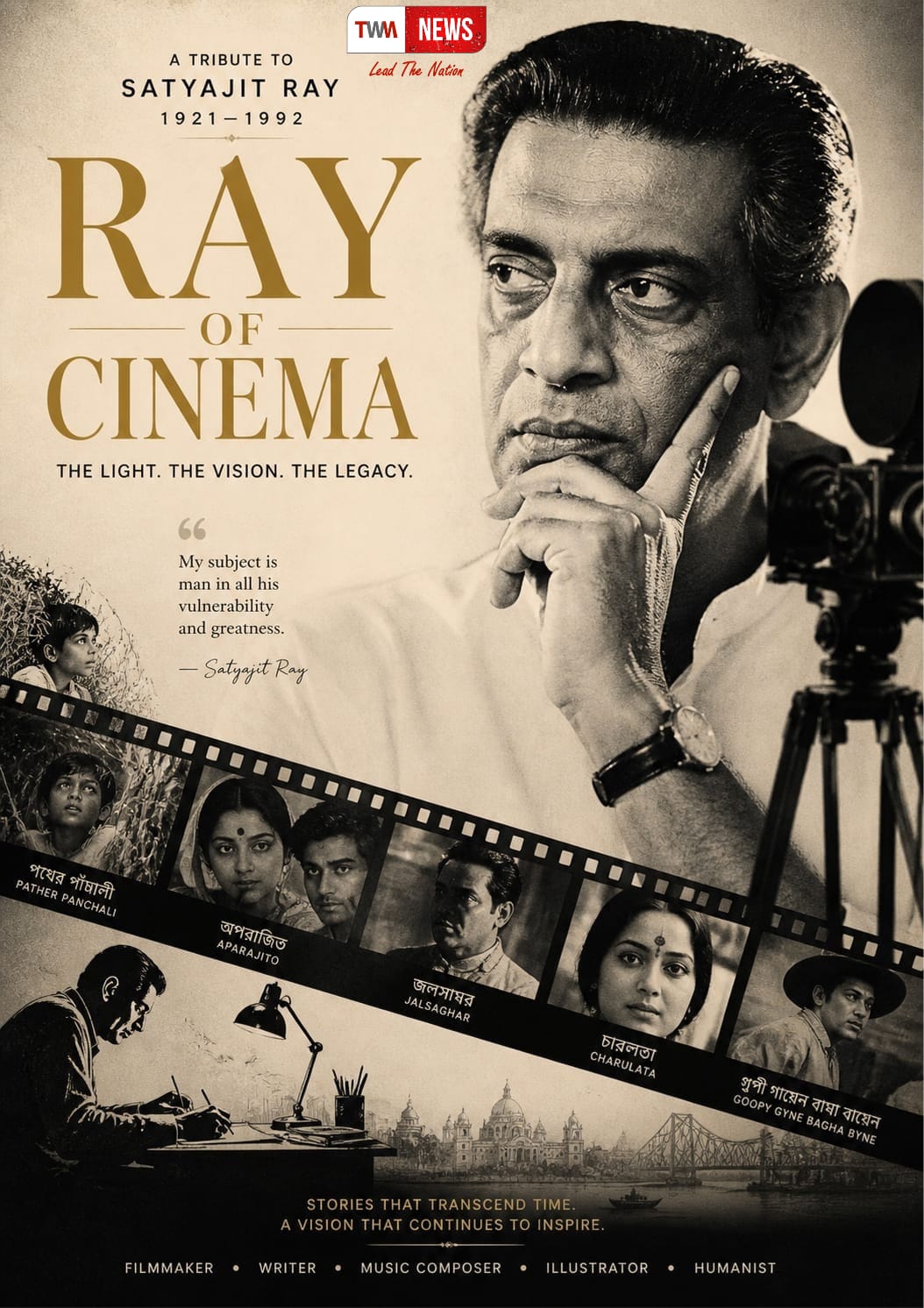
Ray of Cinema: The Humanism That Still Breathes Through Frames
OPINION
By Nihal Kumar Dutta & Amar Sharma
There are filmmakers, and then there is Satyajit Ray a name that transcends cinema and enters the realm of philosophy, literature, and human understanding. On his birth anniversary, remembering Ray is not merely an act of tribute; it is an engagement with a cinematic mind that reshaped how India and the world perceived storytelling.
Ray’s cinema was never loud, never desperate for attention. Instead, it quietly observed life, capturing the subtle rhythms of human existence. His films often functioned as what can be called a “prison-house of humanism” a space where characters are bound not by physical chains, but by social realities, emotional conflicts, and moral dilemmas. Yet, within these confinements, Ray discovered profound freedom: the freedom to feel, to empathize, and to reflect.
Take, for instance, Pather Panchali, a film that did not rely on spectacle but on sincerity. Through the eyes of Apu, Ray introduced audiences to rural Bengal with such authenticity that it blurred the line between cinema and lived reality. Poverty was not dramatized it was humanized. Similarly, in Charulata, Ray explored loneliness within the confines of an upper-class household, presenting a nuanced portrayal of a woman’s emotional and intellectual isolation.
What makes Ray’s cinema enduring is his unwavering commitment to humanism. His characters are never reduced to stereotypes. They are flawed, vulnerable, and deeply real. Whether it is the decaying aristocracy in Jalsaghar or the aspirational struggles in Aparajito, Ray’s lens remains compassionate, never judgmental.
In today’s fast-paced cinematic landscape, where narratives often chase commercial validation, Ray’s work reminds us of the power of stillness. He believed in the silence between dialogues, the expressions between cuts, and the emotions that linger long after the screen fades to black. His films demand patience but reward it with insight.
Beyond filmmaking, Ray was a polymath writer, composer, illustrator each facet contributing to his holistic storytelling. His cinema was not just seen; it was felt, heard, and experienced in its entirety. This interdisciplinary genius allowed him to create worlds that were both intimate and universal.
As we celebrate his birth anniversary, it becomes essential to revisit Ray not as a relic of the past, but as a guiding force for the future of cinema. In an era of noise, Ray teaches us the value of listening. In an age of excess, he shows us the beauty of restraint.
Satyajit Ray was not just a filmmaker he was a mirror to society, reflecting truths we often choose to ignore. And perhaps, that is why his cinema continues to resonate: because it speaks not just to the audience, but to the human condition itself.
—End—