
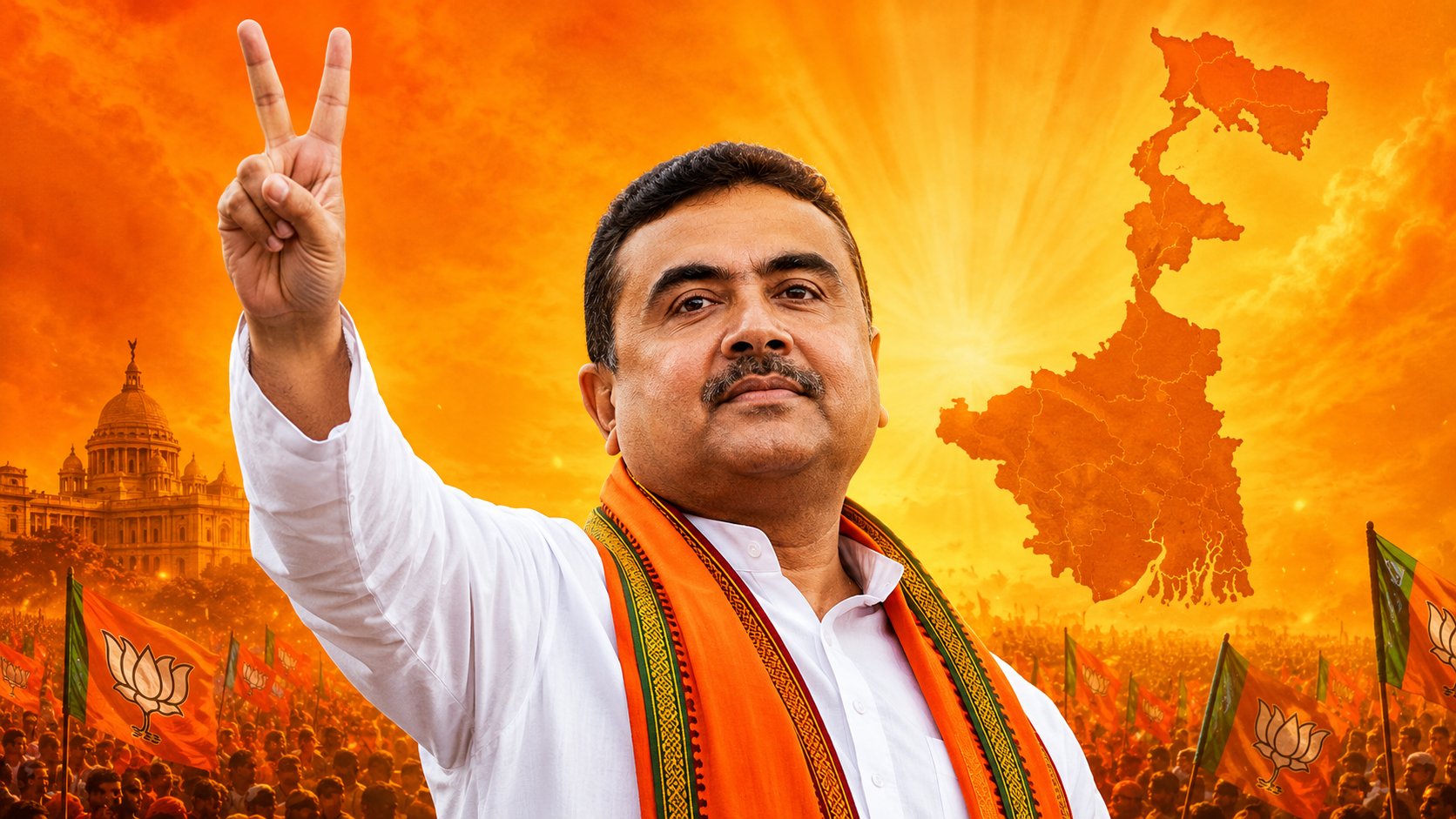
The Dhurandar of BJP in Bengal
Amar Sharma | Edited by Nihal | TWM News
In the ever-evolving theatre of Indian politics, few narratives carry the dramatic weight of West Bengal’s 2026 political transformation. What unfolded was not merely an electoral shift—it was the culmination of a long, calculated restructuring of power. At the center of this seismic change stands Suvendu Adhikari, a figure whose rise represents both strategy and symbolism in equal measure.
From the early counting trends of May 4, 2026, emerging across hundreds of counting centers, it became evident that Bengal was witnessing the end of an era. The dominance of Mamata Banerjee—a towering force in state politics for over a decade—was being systematically dismantled. And leading that dismantling was a man who once stood at the very foundation of her political empire.
The Making of a Political Architect
Born in the politically active coastal belt of Purba Medinipur, Suvendu Adhikari’s journey is deeply rooted in grassroots mobilization. Unlike leaders shaped solely by ideology or charisma, his strength lay in structure—booth-level networks, district command, and personal trust chains that extended deep into rural Bengal.
His early career, beginning as a Congress councillor and later transitioning into the Trinamool Congress, was marked by consistent electoral success. But it was not victories alone that defined him—it was his ability to build systems that could deliver those victories repeatedly.
Nandigram: The Defining Chapter
If one moment forged his political identity, it was the Nandigram Movement.
The protests against land acquisition were not just a local uprising—they became a turning point in Bengal’s political history. Suvendu Adhikari emerged as a key organiser, translating local resistance into a statewide movement. Ironically, the very machinery that helped bring Mamata Banerjee to power in 2011 would, years later, be repurposed against her.
This paradox lies at the heart of Bengal’s political transformation.
From Insider to Challenger
Within the Trinamool Congress, Adhikari was more than a senior leader—he was the operational backbone in South Bengal. His influence extended across multiple districts, where electoral outcomes were shaped through networks he had personally cultivated.
However, the internal dynamics of the party began to shift. The growing prominence of Abhishek Banerjee signaled a transition from a decentralised, field-driven model to a more centralised leadership structure.
This was not merely a clash of personalities—it was a conflict between two political philosophies:
- Grassroots legitimacy vs centralised authority
- Organisational merit vs dynastic consolidation
For Adhikari, the shift represented a structural departure from the principles that had built the party’s success.
The Turning Point: Defection and Rebuilding
His move to the Bharatiya Janata Party in December 2020 was not symbolic—it was strategic. With him came a vast organisational network that BJP had long lacked in Bengal.
Under the broader framework of Bharatiya Janata Party, Adhikari began reconstructing a parallel political structure—one capable of challenging the entrenched dominance of the Trinamool Congress.
The 2021 Nandigram contest, where he defeated Mamata Banerjee, was not just an electoral upset—it was a psychological breakthrough. It proved that even the most entrenched leadership could be challenged at the grassroots.
The Opposition Years: Strategy Over Silence
Between 2021 and 2026, Adhikari’s role as Leader of Opposition was marked by sustained political activity. He ensured that BJP remained visible, vocal, and organised.
From raising issues like the Sandeshkhali crisis to mobilising support around citizenship policies, his approach was consistent—convert every political issue into a structured campaign.
This phase was less about headlines and more about groundwork. And it paid off.
2026: The Collapse of an Empire
The 2026 Assembly elections were not a surprise victory—they were a prepared outcome.
Winning from both Nandigram and Bhabanipur, and defeating Mamata Banerjee in her own stronghold, Adhikari’s triumph symbolised more than a change in leadership. It marked the collapse of a political model that had once seemed unshakeable.
The oath-taking on May 9, 2026, as Bengal’s first BJP Chief Minister, was not just a personal milestone—it was a historic redefinition of the state’s political identity.
A New Political Doctrine
As Bengal enters a new governance phase, the expectations are immense. Policy directions indicate a focus on administrative restructuring, citizenship frameworks, and institutional accountability.
But beyond governance, what stands out is the method of political transformation.
Suvendu Adhikari did not rise through sudden waves or external imposition. His ascent was engineered—layer by layer, network by network, over decades.
The Final Word
In the end, this is not just the story of one man’s rise. It is the story of how political systems evolve—and how they collapse.
Mamata Banerjee built her empire through mass mobilisation. Suvendu Adhikari dismantled it using the same grammar of politics—ground connection, organisational depth, and strategic patience.
The lesson is stark and enduring:
Power built on structure can only be defeated by a stronger structure.
And in Bengal, that structure now has a new name—
The Dhurandar of BJP.